Monday, October 17, 2011

It's a bird. It's a plane. It's a…Rooster?

 It's always a rooster.

You latch onto one of your little chicks or five-week-old pullets. You decide she's your favorite. You love her. You give her a cute name. You call her things like cutie pie, fluff ball and fuzzy butt. You know you're little girl is a hen. I mean, look at how cute she is. Then all of a sudden she either sprouts a giant tail, doubles in size, or suddenly lets out a noise that is by no means a cluck. Yup, she's a he.

When Rooster Disaster (RD) happened to us for the first time, it happened to strike our first batch of chickens. We had gotten three "hens" and each picked one out to name. RD struck my husband's chicken. The ironic part of the whole thing is that his name was Mrs. Nesbitt. The name came from the movie Toy Story. In the second half of the movie, Buzz and Woody are stuck at Sid's house and Buzz has been recruited for Sid's little sister's tea party. He is dressed up in a hat and apron and has lost one arm in a fall. When Woody finds him in this state, Buzz says, "I'm Mrs. Nesbitt!" But, I digress...Maybe it's not so ironic, since Mrs. Nesbitt is actually Buzz, who is a boy. Maybe my husband doomed his chicken with the name.

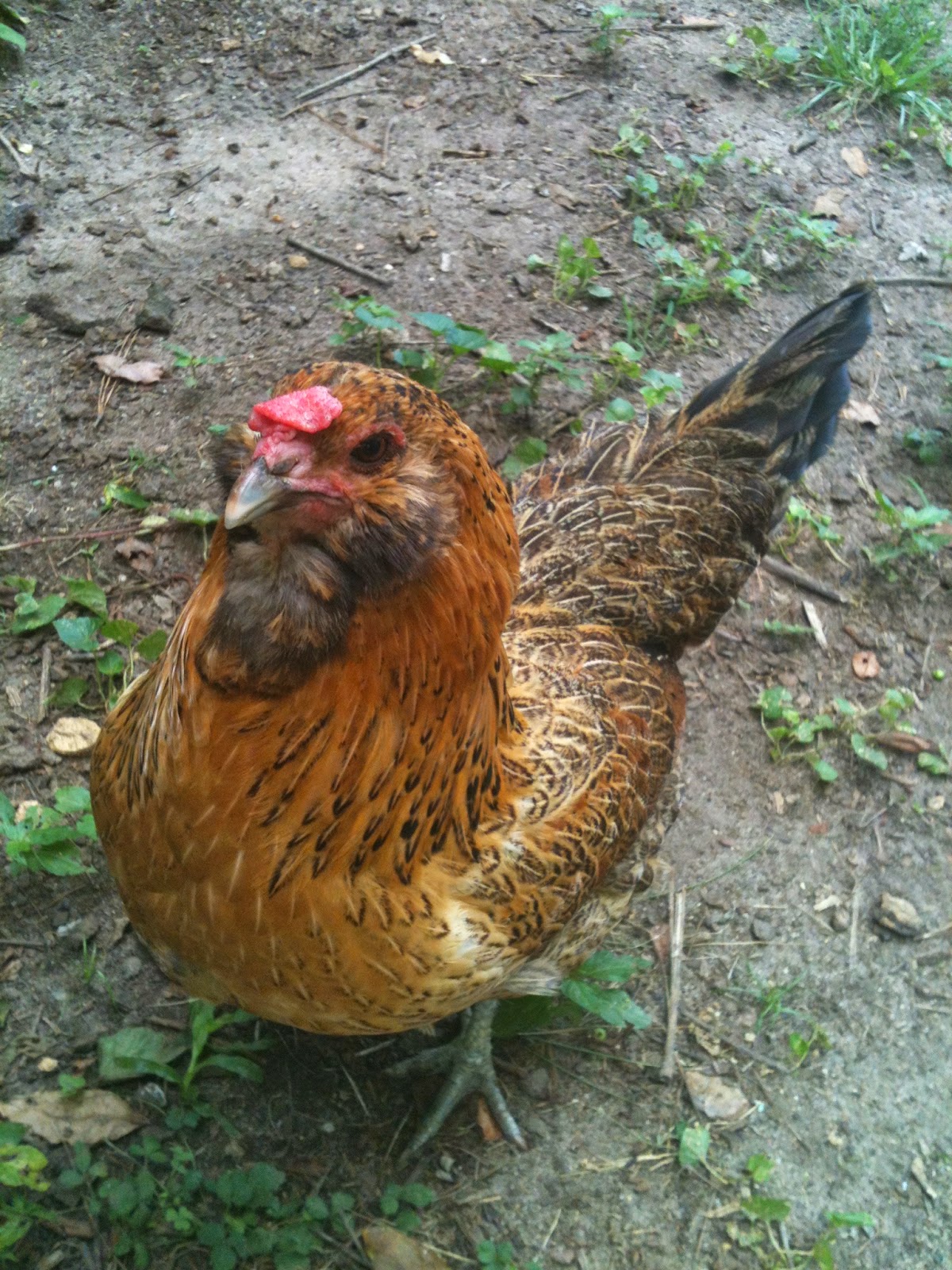
I am now in the throws of this same problem once again. Well, I may be in the throws of this problem. We are down to one of the adopted little bantams that Erickson hatched out in June. Two went off to a friend last month. This weekend we dropped off two more with The Chicken Man. So we're down to Boba (as in Boba Fett from Star Wars). We were supposed to be dropping off a rooster and a hen with The Chicken Man, but he suspects we had two little roosters for him. Then, I started looking at the one we have left. Three of the chicks were identified as definite roosters pretty early in life. They had large combs and obvious rooster tails. The two little white and black chicks have always been definite girls. They had perfect little straight-in-the-air tails and small combs and wattles. Suddenly, however, I notice that our two girls each have two long tail feathers that look suspiciously rooster-esque. It's going to be RD all over again.

Being the fervent researcher that I am, I just finished combing through all of our pictures of the chickens on our computer as well as googling images of Japanese and Old English Game hens. These crazy boyish tail feathers have materialized in the last month. They did not exist in the pictures we have from September. The problematic part of this story is that I found no pictures online of hens with these long tail feathers. Ugh! I did find a few adolescent roosters who look similar to my cute little "girl."
A cute little girl?


I need a farm in the country where it's not an issue to have giant (or in the case of Bobba - tiny) roosters cock-a-doodling around the yard. Then, I wouldn't be so worried about this sexing mess. She/he has just hit 4-months-old, but I'll keep you posted on whether or not I get a first egg or a first crow.
Or a Roo? 

Thursday, October 13, 2011

Old MacDonald had a farm, E-I-E-I-O.

Chickens are a gateway drug. You think to yourself, I'd like to have a few chickens in my backyard... I want to be closer to my food... It would be much healthier to have fresh eggs... I can teach my children about where our food comes from... It would be fun to watch chickens pecking around the yard. Then you get a handful of chickens to fulfill whichever of these thoughts you had. And that's your big mistake.  Next thing you know, you have built an addition onto your coop and have three chickens over your city's legal limit. I'm just saying.

Chickens are cute. They're fluffy. They're fun to watch. They eat bugs that would otherwise be crawling around your backyard and eating your flower or vegetable garden. They make you eggs. Some of them are so sweet they act like lap dogs. What's not to love? My husband could think of plenty of things not to love. When I first broached the subject of chicken-owning a little over a year ago, he was not as gung-ho about it as I was (that's an understatement).

I have always liked chickens. My grandfather had chickens when I was a kid. My uncle and aunt had chickens when I visited them in Wyoming (I still remember their beautiful little golden hen named Goldie. I took her picture while she was sitting on her nest.). However, my personal love of chickens was previously contained to inanimate chickens. I had chicken salt and pepper shakers, a chicken candle, a few chicken statues, and a chicken pitcher, but no actual chickens living in my yard. I live in the downtown area of my state's capital city. I enjoy the city life. I generally think of myself as a city girl with a little hometown flair. So live chickens never crossed my mind. That is, they never crossed my mind until I met The Chicken Man. I met him through work, where I found out he had chickens and where he brought a four-hour-old baby chick to visit us one day. I fell in love with that little fluff ball and wanted to take it home right then and there. Not long after that day, The Chicken Man donated more than a dozen chickens for us to raise money for a charity walk for which we were trying to raise around $5,000. A few of us went out to his house to see his 40 or more chickens. As I was driving home from The Chicken Man's house I decided this was a perfect way for me to raise the money I'd pledged for the walk and get a few chickens for myself. I just had to convince my husband.

At first, my dear hubby thought I'd drop the idea. This was just another hair brained idea I had that would never come to fruition. Then he tried putting obstacles in my way when I didn't forget about "the chicken idea." Can we have chickens? How many? We have to ask the landlord. I've said before that I'm a researcher. I didn't spend four years of college studying English and writing papers for nothing. I spent hours on the internet. I checked out books from the library. I talked to the landlord. Then one day he asked when we were getting the chickens. Actually, I may have said something about how we had about two weeks before the chickens were coming and the coop needed to be built. But who cares about those little details?

At first he was fine with the chickens. He liked them, but wasn't in love with them like I was. I'd go out first thing in the morning to open the coop and give them a treat. I went straight out to check for eggs and say hello when I got home from work. He would sit outside with me in the evening or on the weekends and watch them forage and sometimes he'd check for eggs. He wasn't so in love with them that when Erickson, our buff Brahma, went broody he thought getting eggs for her to hatch was an awesome idea. It's not that he hated the idea, it's just that he needed to warm up to it. He looked at me like I was a lunatic when I brought home seven fertile eggs for her. Then I got to hear about how we couldn't keep all of them. First, I convinced him that keeping one was okay (I really would've loved to keep three), then I had him up to keeping two, kind of. Now, we're keeping one and swapping the second one we were going to keep for a Silkie. Sigh.

Do you see the trend here? Well, besides my drug-like addiction to the chickens? Not long ago, I noticed my husband was almost always the one who collects the eggs. He gets them before I've gotten a chance. He's always telling people how great it is to have chickens and how relaxing it is to watch them pecking around the yard. During the work week, he lets them out when he comes home on his lunch break so they get some nice foraging time. He brings them treats everyday. And when our not-so-bright bantams decide to sleep outside on the perch when it's raining, he's the one who goes out and puts them inside the coop so they stay warm and dry (I say if they're that dumb, let them sit out in the rain. They'll learn or get wet.).

The scary part of chickens is they're so addictive that even the reluctant chicken owner gets sucked in. You can't help it. Now, my husband wants to move out to the country and start a chicken farm. I'm down with it. He says it's the only way I can get a goat.


Thursday, September 29, 2011

It's All in the Egg

Of course, any person who has been in a grocery store knows that hens lay different sizes of eggs. Some hens lay large eggs, which some lay medium-sized eggs and some lay small eggs. And everyone knows that eggs come in different colors. The standard grocery store eggs are either brown or white. Chicken aficionados know that eggs can also come in olive, chocolate brown, and varying shades of blue, green and pink. You might find it interesting to know that hens also lay eggs of different shapes. We can tell which of our hens has laid which egg when we collect them from the nest boxes. It helps that we only have four laying hens at the moment. Though it won't be hard when the youngest two start laying because they're bantams and will lay tiny white eggs -  not hard to distinguish from the larger brow eggs we're already getting.

You might be wondering how chickens can lay different shaped eggs. Well, it's not like one hen lays oval-shaped eggs and another lays rectangular eggs. Except for that one time, but maybe I'll save that one for another post. An egg is shaped based on the passageway out of the hen. Some eggs are narrow, some are pointy, some are quite round, and some are just odd looking. Seeing is believing, so here are examples of our girls and their delicious, yet differently-shaped eggs.

Meet Bossy. She's a Barred Rock. Some might call her a Plymouth Rock.

She lays large brown eggs. They are always the biggest of our four hens' eggs. Though the others are catching up in size.

Next, meet Pouncey. I call her an Ameraucana, but she is more accurately a mutt. She's an Easter Egger crossbred with something else.

Pouncey's eggs are a little smaller than Bossy's and are severely oval in shape. They're sometimes almost pointy at the top. They're lighter in color too. Lately, they've gotten a bit larger and are getting almost too similar to Bossy's to tell them apart.


Then there's Erickson, named by my son after his best friend. She's a fluffy and fat buff Brahma. Her eggs are fat. They have a roundish shape to them.

Last, but not least, we have Ochocinco. She's an Iowa Blue that's probably got a little something else mixed in there too.


She's was making quite a loud barking noise when this photograph was taken. That's how she rolls. Her eggs are the smallest of the four girls. They are cute and little. Her eggs usually have little raised spots all over them. They're little buildups of calcium. Apparently, this trait is hereditary. 

It's interesting how varied eggs are. What you see in the grocery store is a mass-marketed product of what someone decided was egg "perfection." Wouldn't it be cool to go to the store and be able to buy chocolate brown or pastel blue eggs? Or there could be like a grab bag carton that had a variety of colors, sizes and shapes. I'd buy them. Well, I'd buy them if my own hens weren't laying me a third of a dozen eggs a day nearly for free.  


Monday, September 19, 2011

Coop of Personality

Here's my ultimate wisdom from my near year of raising chickens. Wait for it. Wait for it. Every chicken is different. Aren't you amazed? The thing is, I mean it. I'm a planner and a researcher. I majored in English in college and went on to perform a short stint as a high school English teacher. I love writing a good research paper. More than writing the paper, I love researching for a paper. I carry this skill with me in my regular life (as I'm sure you're starting to pick up on if you've read any of my other blog posts). I read a bunch of books and did hours of research online before we got chickens. I read about their development, the different breeds and their characteristics, coop design, predator problems, feeding chickens, and anything else I stumbled upon in my quest for chicken knowledge. I'm still reading and learning about chickens and I'll have gotten chickens a year ago come October. Along with all that I've learned during my research, I've also learned that everything you read is not going to be true for your chickens. Hence my epiphany: every chicken is different.

What I mean by this remarkable piece of knowledge is that just because a chicken is a particular breed or gender, does not mean that he or she will follow the standard protocol you've read. Take the Brahma. They are a dual purpose breed (meaning they are raised both for eggs and meat) who are medium layers (in terms of frequency), are often known to go broody, lay well throughout the winter, have a docile temperament, and bear confinement well. My buff Brahma hen, Erickson, was docile until she went broody and hatched her clutch. Now, months later, she is trying to usurp the top spot in the pecking order, is mean to the hens lower than her in the pecking order, and clamors to get out of the run whenever someone goes out to open the door (to let them out or not). She is an excellent layer, laying a medium-sized brown egg at least 6 days a week. So she follows the standard protocol about half of the time. On the other hand, you may have a breed of hen that most people say are great layers and never go broody and yours lays half the time and has tried to go broody twice in as many months. I've learned that it's nice to read the information and get a baseline for the kinds of breeds in which you're interested, but don't be discouraged when things don't go the way you've planned and know that it doesn't mean your particular girls (or boys) are going to do what the internet says they should be doing.

We, as adult human beings, are wired for disappointment. We get all excited and set our expectations for one thing and have a long way to fall when those expectations aren't met. I say, don't do that with your chickens. But honestly, I think they're so cute and so much fun that they make it pretty hard on you to be too let down. Will you be sad when half of your chicks turn out to be roosters and you can't keep all of them? Yes. Will you hate it when none of your chickens are super duper friendly like you've seen on BYC and you think you've done something wrong because none of them will jump up into your lap? Uh, yeah. Will you be disappointment when your "Easter Egger" lays brown eggs instead of blue or green or pink eggs? Big time - I know about this one first hand. Will you love all of your chickies more than you thought you could love birds that live in your backyard? Sure thing. And that's what happens to just about everyone who starts a backyard flock. Then one day, you'll be a salty old veteran chicken farmer and you'll roll with the punches. I try to keep my sodium levels down, but I'm pretty excited about getting to the salty old stage.

Wednesday, September 14, 2011

Crazy Chicken Lady

Let this be a warning for people who want to start raising chickens or who are just starting to raise chickens. You're about to embark upon something that is bigger than you are. I say these things because I am in love with the website www.backyardchickens.com. I check in there nearly every day. Okay, every day. I'm obsessed. My favorite part is the forum where members can post questions and other members can reply. People share pictures and stories of their chickens. Other people ask questions about raising chicks, chicken behaviors, illnesses, breeds, and anything else you could ever imagine that deals with chickens.

One recent thread on the forum made me realize something about myself. I'm a crazy chicken lady.

Someone started a thread with the following phrase, "You know you're addicted to chickens when…" Of course, I clicked on it, read many of the responses, and then added my own. But it got me thinking. I have a serious chicken problem. I'm not to the level of crazy where I have any live chickens in the house (though I might be if I were single or if my husband was not adamantly against having a chicken in the house. He won't let me get one-day old chicks - yet - because they'd have to live in a crate in the house for quite some time). Even so, I'm pretty sure I'm already one chicken over the legal limit for where I live, which is inside city limits; however, that one is getting ready to go off to live with The Chicken Man, and another may be going to my parent's flock, so I don't feel bad about it. I'm already working on my husband about getting a Silkie. I desperately want one. You might say, "Well, LovinChiknFarmin, that's not so bad. Lots of people who raise chickens want more than they're supposed to have and favor particular breeds." My Crazy Chicken Lady-ness is not solely based on these two things. I've compiled a list. You're going to judge me.

The following list is comprised of things I own or do that I believe contribute to my obsession.
- Rooster salt and pepper shakers
- A collage of pictures of my family and our chickens, which was a birthday gift and hangs over my bed
- Chicken and Egg, a combination memoir and cookbook (also a birthday gift). Awesome book. Read it.
- I write this LovinChiknFarmin blog (seriously, you didn't see that one coming?)
- Daily monitoring of www.backyardchickens.com (BYC)
- My cell phone background picture is currently of my chickens
- A chicken hat (a hat that when you're wearing it looks like a chicken sitting on your head)
- A Mosaic Rooster that is in my garden
- Plastic rooster lawn ornament outside by the chicken coop
- I keep containers of scraps in my fridge to feed the chickens
- I'm currently contemplating keeping a baggie in my purse so I can bring home any little tidbits my chickens might like…I already take home pizza crusts or any leftover bread from restaurants when getting a to-go box
- Rooster kitchen timer
- Handmade wooden chicken statue on my desk at work (there are two more at home)
- Multiple chicken/rooster statues throughout my house
- Chicken coffee mug
- Chicken serving platter
- Chicken pitcher
- Basket made of chicken wire with a metal chicken on each side
- Eggs cookbook
- Borrow any chicken book I come across from the library
- Occasionally check out Mypetchicken.com to see what kinds of hatching eggs they have for sale or to see pictures/info on different chicken breeds
- Buy Chickens magazine published by Hobby Farms
- Chicken hand towels (multiple!)

Hello. My name is LovinChiknFarmin and I am a Crazy Chicken Lady. It's a disease, really. A chronic disease that you just have to learn to live with. Well, I'm off to BYC to see what all the peeps are up to today...

Thursday, September 8, 2011

Crazy Freakin' Chickens

I'm finally back after a bout with strep throat. I'm glad  to be back. Today was the first day I've spent any quality time with the chicks since I got sick over a week ago. I sat with them while they free ranged in the yard and fed them treats. They were jumping around and off the ground to get the treats as I was handing them out. I even got one of the bantams, a little roo, to take food out of my hand! That's a first. The bantams are such spazs that they've not been easy to domesticate.

In terms of the spaz mob, we've had a major change since August. There are two less bantam Japanese-Old English Game roosters in our coop. They now reside in the countryside where I went to high school in Oxford, North Carolina. Their new dad, someone with whom I went to high school, is a big time chicken lover and so are his two little girls. I know those little roo's - Luke and Han - went to a good home. They were in their little temporary pen preening and checking things out when we left them. Back at home, the others don't seem to notice that they're gone. Their absence has to be good for the remainder of the flock because space was getting a little cramped with five bantams growing like weeds out there. Nighttime roosting was getting tight and treats don't go as far with five extra mouths to feed. Next month the final bantam rooster will be moving out to live with The Chicken Man. And then there will be two bantams and our four original big mamas. Here's to hoping the absence of so many tiny roadrunners will allow my girls to calm down again. They've gotten awfully pushy lately.

For some reason the chickens have become especially crazy in recent weeks. When we go out to feed them, they are all over the coop and jumping and trying to get out the door when you open it. I literally have to put my foot on Erickson's chest when I open the door to bring them their morning treats. For one thing, the dogs go out in the yard with me in the morning and we would probably have one less chicken if they got out when the dogs are out. And two, I don't have thirty minutes of leisure time in the morning to let them out to forage in the yard. They do not look kindly upon short stints of freedom. They revolt actually. They've always been fond of their treats, as I wrote about last time, but lately they've become little savages. They now try to tear your hand off when you're dolling out the treats while pounding the hell out of each other to steal each others finds. It's insanity. I'm not sure what has started the crazy savagery except what I mentioned above: treats are thin with five more mouths to feed. Yes, we generally bring out more scraps than we did when there were only four girls, but I'm sure the ratio of treats to chickens has shrunk. I only have so many scraps from a family of three people!

Besides the food savagery, the tiny bantams are balls of nerves that have to be making the big girls anxious. The littles are like roadrunners and doves all rolled into one. They fly around in the coop when they get scared or nervous and if you saw them from afar you'd think we were keeping doves or pigeons out there. Except that they are the fastest little chickens I've ever seen. Image me and my husband wrangling them up and trying to put them in a pet carrier for transport last week. It was crazy. It didn't take very long; I'm pretty good in my chicken catching skills. Our only major problem was that one escaped after he was captured and put in the carrier, so we had to start over and catch another one. I'm sure our neighbors, who happened to be in their backyard while all of this drama was transpiring, got a nice show. We must have looked like lunatics out there. Let's not talk about how my four-year-old son thought one of the roosters was dead because of the way he was hanging (seemingly limply) from my hand when I was holding him upside down by his legs until I could get him in the carrier.  It may be standard chicken handling to most chicken-savvy adults, but not to a four-year-old, albeit it a chicken-savvy one.

So I have a crazed mob for a flock of chickens and we're headed into fall and winter. Bossy, the Barred Rock and once head of the pecking order (I'm trying to figure out if she's still in charge. Erickson has become pretty witchy and is throwing her weight around a lot lately), started molting a bit. She looks a little ragged right now with her head and bum feathers a little sparse. I'm waiting for the rest of her to molt all at once so she looks like she has the mange. That would be just like her to do. Then the eggs will begin to taper off. I'm most sad about that part of the coming months. I love our delicious eggs. That's okay. I'm trying to convince my husband to add a Silkie to our flock, so seven chickens would certainly give us enough eggs to make it through the winter, don't you think?

Saturday, August 27, 2011

Growing Chicks

When we decided to let our broody Brahma hatch eggs, I was terrified, as I've mentioned before. I had no idea what I was doing. And as our happy soon-to-be Mama hen sat on all of these eggs, I suddenly realized we were in way over our heads with this one. Of course, I kept that little piece of thought to myself as my husband was originally less than thrilled to get chickens in the first place. He had grown to love them and was totally behind the idea of letting our Brahma hatch some eggs to get over her broodiness, but I felt like this was my venture so I needed to know what I was doing. And, I assumed my husband expected that I knew what I was doing. Why else would I have been so hung ho about hatching chicks? I am the chicken lady in our family. So, I took to the internet and checked out a new chicken book from the library (I'm nothing if not a planner and researcher) and I've already written about hatching those cute babies.

Once they were here, I scoured all of my resources including the two chicken books I already own and could find little in terms of a timeline for my expected babies. I wanted pictures. I wanted charts. I wanted to know what to expect and when to expect it. Now, I understand that all chickens are different. Raising chicks is like raising children in the fact that all the "What to Expect" books and the parenting magazines warn you that all children are different and some develop at a slower or faster rate than others. But I seriously wanted some sort of flow chart to follow so I'd know what to expect. Why hasn't anyone written a What to Expect When You're Expecting Chicks book? It could start with the development of the chick in the egg as it's sat on by the hen. Then the chapters could be divided by week with each week having a description of the types of things your chicks should be doing and thing they might start doing. Then it could answer common questions people have about raising chickens. I mean, this sounds like a money maker to me. I've read the chicken forums. People raise chickens and hatch eggs and have no idea what they're doing. This sucker would be a huge seller in hardware and feed stores. Just saying.

I'm going to give a basic timeline for the clutch of chicks we hatched. I'm going to start at hatch and go through 8 weeks. They're a few days away from being 11 weeks old. The biggest changes happened between hatching and 8 weeks. The past few weeks they've mostly just grown and integrated more and more with the flock, so in terms of development it's not as exciting as those first 2 months. You may find that your hatching experience is different or that your breed of chicken developed differently or at a different pace. I completely expect that to be true and I'd love for you to share your experiences below. I've only experienced the hatch of one clutch, so that's all I have to go on.

This is the story of 5 Japanese-Old English Game Bantams. Keep in mind they are super tiny since they're bantams. Let's get started:

Week 1: It took three days for all of the eggs to hatch. When they first hatch out, they're super tiny and look wet, but within the first hour they become the fluffy little chicks you expect. They make constant peeping sounds.

This is the first baby to hatch. She's less than an hour old.

Here they are on Day 2.

Week 2: They are all out and about. They stick to Mama as closely as possible. When she finds food she makes a particular clucking sound that alerts them that she has something to eat and they come running. They still look like little fluff balls except by the end of this week their wings are feathering out and they're starting to grow tiny tail feathers. The color of their fluff is not necessarily any indication of the color of their feathers. They're easily caught and picked up, though they make frantic peeping noises when you do it. During the day they are super active. They like to scratch around a little in the dirt. They climb all over Mama's back and sit on her. Sometimes they try to burrow under her wings when she's sitting with them. They like to sit in the sun and sun themselves. They take lots of little naps during the day - they'll just plop down somewhere in the dirt and fall asleep. Peeping is still constant. At night, they all climb into the nest box and burrow deep under Mama. You can't even tell they're there.


 They're getting ready for bedtime and are about to climb in and burrow under her wings
 and in the back of the box under her bum for the night. 

Week 3: Feathering continues and the chicks' backs and chests begin to sprout feathers. The tail fathers have grown out longer. They preen themselves obsessively. They still stay fairly close to Mama and she still gives the food call. They eat and drink when they're hungry, but take a lot of cues from Mama. They forage when she does and stick close most of the time, but once in awhile one or two chicks wander off a little in the run and scratch and forage for themselves. They're beginning to realize that if they hide in the corner, they have more of a chance to eat what they've found or stolen away from the others! (Note: This week was the week of the 4th of July. We were out of town most of this week and my sister chick-sat, so there aren't any example chick pictures.) 

Week 4: They're roosting now. They've nearly tripled in size since they hatched. They are now strange chick/chicken hybrids. They have fuzzy chick heads and feathered bodies. Their chests are in the final stages of feathering, so there's still a little fuzz poking out in places. Still constant peeping from everyone. Mama is still mothering them and they mostly stick close to her, but they go off on their own a lot. They generally stick to the buddy system and have at least one other chick around near them at all times. Some of them still try to snuggle with Mama when she's laying in the sun. They even interrupt her dirt baths to get on top of or near her. Personally, we let the chicks out to free-range with Mama at this age. They stick right by her and love scratching for bugs and tidbits all over the yard. She does not let the other adult hens near them and gives a warning call before attacking if someone gets too close for comfort. Their combs are much more pronounced. If you're familiar with chickens and hatching at all, you can generally tell by the comb how many roosters and hens you have at this point (some breeds make this identifying a little harder, so it's not always the easiest task). I can tell that we have at least two roosters at this point. They're very curious. A piece of hardware cloth divided the chicks and Mama from the rest of our flock. The two areas were next to each other, so they could see each other through the wire and spent lots of time contemplating each other. 
Roosting on the mini-roost we put up for the chicks and on part of the coop structure dividing the two areas. 

A close up of one of the roosting roosters. Notice the still fuzzy head. 

Week 5: Their heads are working on catching up with the rest of their body! Feathers are sprouting, but you can still see a little fluff too. They actually look like mini chickens now and not chicks anymore. I won't be able to call them babies for much longer (though I'll continue calling them chicks throughout this entire piece to be consistent). Their combs are even more pronounced than last week and it seems that we have 2 hens and 3 roosters. When they're out free-ranging, the chicks will wander a little farther away from Mama. She's still in their sights, but they'll go quite a few feet away without worrying. One of the chicks is  a free adventurous spirit and goes off halfway across the yard by himself. At the end of this week we integrated the chicks with the rest of the flock. They've been free ranging for nearly two weeks and the adult hens and the chicks have free-ranged alongside each other without any problems (besides Mama getting cranky). A pecking order has to be established, so some pecking and chasing has ensued; otherwise, the merging of the two coops is going well for us. Oh, I almost forgot. Still with all the peeping. 

Week 6: This week is more of the same: they are growing bigger, continuing to peep, loving to forage and scratching for anything edible. They love bugs. Big time. They've gotten the routine down from the big hens. They join in with the rest of the flock when it's time for The Food Lady to appear. They love treats. They are super fast little buggers and it's an event to catch one of them. But you know I do it anyway.  

Week 7: There is no sign of fluff on the "chicks" anymore. Since they're bantams, their size is the only thing that still makes them look like chicks. The roosters have nice tall combs and beautiful iridescent tail feathers. The girls are fat little beauties. They're still growing rapidly. It's not so apparent when you look at them every day, but looking back at pictures from just a few weeks ago shows how much bigger they've gotten. They are just like any other member of the flock. They do everything the big hens do. I haven't seen them dust bath with my own eyes, but I'm sure they must be doing it when I'm not around. That's the only thing that I can't check off my list of "chickenish" things I know they do. They scratch and stretch their wings. They eat out of the big hens' feeder  (even though we still have their chick feeder in the coop) and they've started using the big waterer too. They roost a lot. It's one of their favorite pastimes. Mama occasionally makes a little food alert noise when they're foraging and they still follow her around to a point, but this week seems to show the biggest difference in terms of their dependence on her. They're almost to the point where they are just other members of the flock. (This week also happens to mark the first egg laid by Mama since becoming broody). They're now spending a lot of time establishing a pecking order between themselves. They get into little duels with their neck feathers all fluffed out. It's hilarious to watch.

Scratching in front of their big Mama.

Week 8: The chicks are now simply other members of the flock. Mama is nice to them, but she doesn't help them with food. I actually saw her grab some treats away from some of them when I was giving them their morning treat. They still have a bond with Mama though. When she goes in to lay eggs, some of them follow her into the coop to check out what's going on. They'll hang around near her when they're all hanging out and lounging in the dirt. They seem to have fit into the flock's pecking order. One of the hens, Ochocinco, still throws a peck their way every now and then to keep them in line. They stick together. The incessant peeping continues. They're growing bigger, but there aren't any major appearance changes this week. 

During week 9 I finally saw them dust bathing. It was cute because three of them squished themselves into one of the dust bath ditches in the coop (the hens generally dust bathe in one of a few determined spots in the coop's run). I like to watch them preen. It's so cute because they're so miniature. At week 10 they still have a size disadvantage mostly because of their bantam status. They're getting much bigger though, so space has become an issue in the coop at nighttime. We're passing on the 3 roosters to friends because as urban chicken keepers, we're not supposed to keep them. Next weekend, a few days shy of 3 months old, 2 of them will go off to live in the country with dozens of other chickens. I'm like a scared Mama. I'm worried about how they'll fit in and if the other chickens will be nice to them. I'm sad to see them go. They're my babies. It'll be another few weeks before the last one goes to his new home, so I'm hoping it'll lessen the blow for me.  They're the most beautiful little birds I could've imagined. They're fun to watch, as are our other chickens. They have such huge wings that they can do some pretty good flying. They're can't fly off into the sunset, but they can get some height, especially if they're taking off from our higher roost. 

 The multi-chick dust bath.

Alright, broody Mamas. I'm ready for round 2!